

A cast iron sewer pipe is due for replacement when a camera shows that the pipe wall is cracked, flaking, heavily corroded, or collapsed, or when scale has narrowed the pipe and the problems keep coming back. Age is a warning sign, not a verdict. Many Chautauqua County homes built before 1970 still have original cast iron that is now 50 to 70 years old or more, so an inspection is the right first step. According to McCandless’s sewer line repair cost guide, a full sewer line replacement in Jamestown usually runs about $3,500 to $12,000, with the final number set after the camera inspection. This guide explains the signs, the options, the permits, and what drives the cost.
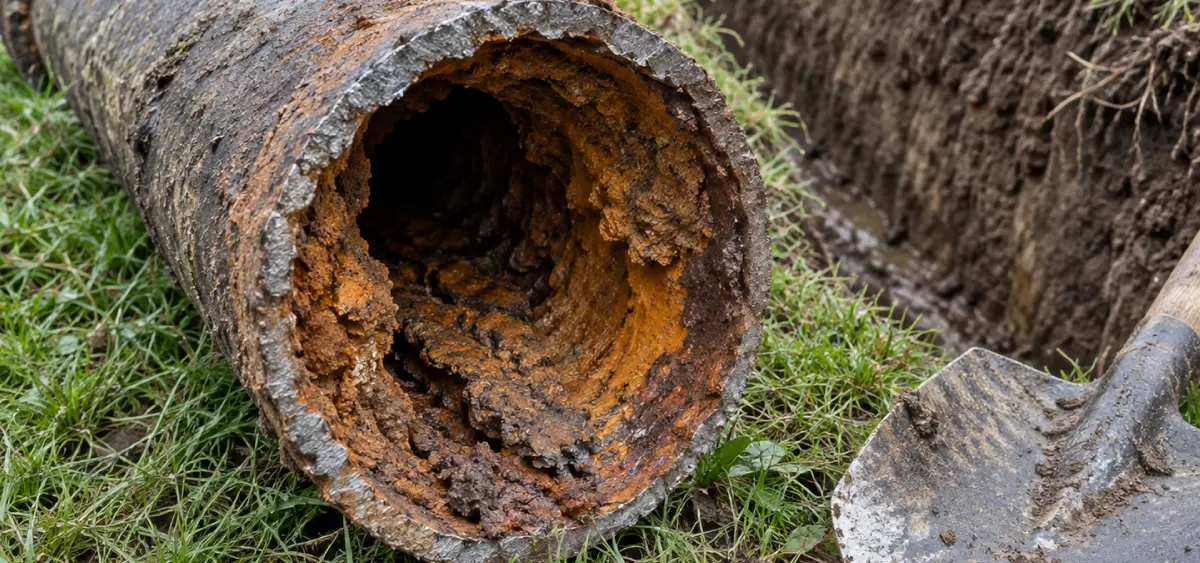
First, Which Part of Your Sewer Is Cast Iron?
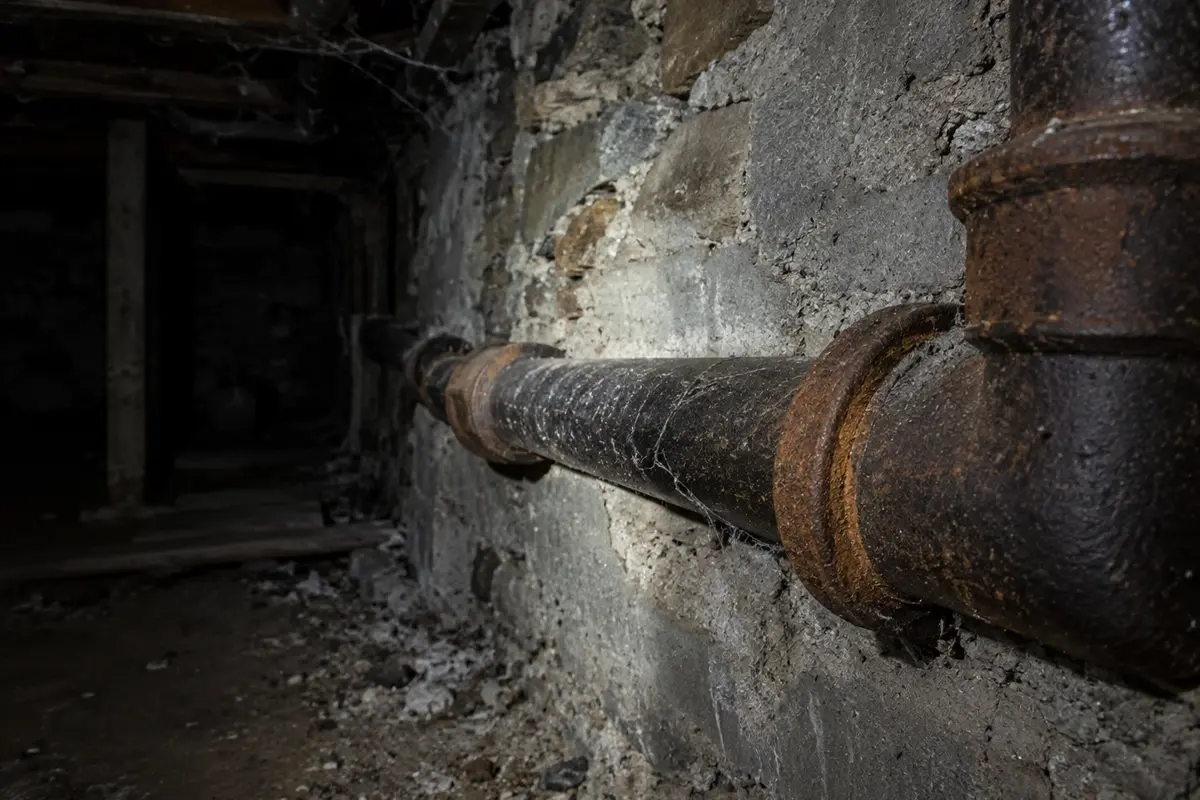
Cast iron is heavy, dark gray, and often has rust-brown bell-shaped joints. A magnet sticks to it, which helps tell it apart from plastic or clay. The cast iron in a home can be in two different places, and the difference matters for the repair.
Jamestown’s sewer code draws the line this way: the building drain is the lowest horizontal piping inside the building, running to a point five feet outside the building wall, and the building sewer is the extension from there to the public sewer. Cast iron can be in either part. Sections inside the house or under a slab are reached very differently from a line running through the yard, and the property owner is responsible for the cost of a building sewer.
How Long Does Cast Iron Sewer Pipe Last?
You’ll often see 50 to 100 years quoted for cast iron sewer pipe, and that range is commonly cited. In practice it varies widely. McCandless’s cast iron pipe page puts typical life at 50 to 70 years, depending on soil conditions, water quality, and maintenance, and recommends an inspection for any pipe over 40 years old.
Cast iron usually fails from corrosion. Inside the pipe, sewage produces hydrogen sulfide gas, which can turn corrosive and thin the wall over decades, and rust scale builds up and narrows the pipe. Outside, soil moisture and chemistry attack the iron. In Western New York, McCandless also points to repeated winter freeze-thaw cycles, which crack aging joints a little more each year. Two pipes of the same age can be in very different shape, which is why the camera matters more than the date on the house.
Warning Signs a Cast Iron Sewer Is Failing
| What You Notice | What It May Mean | Next Step |
| Slow drains or the same clog coming back | Rust scale building up inside the pipe and narrowing the bore | Camera inspection before more cleaning |
| Sewer odors in the basement or yard | Cracks, pinholes, or failed joints letting sewer gas escape | Camera inspection; don’t mask the smell |
| Several fixtures backing up at once | A restriction or break in the main line | Call promptly; don’t wait for a full backup |
| Wet or unusually lush patches along the sewer path | A leak in the underground line | Camera inspection and a locate |
| Visible rust, flaking, or stains on exposed pipe | Corrosion that has reached the surface | Have a plumber check the full run |
If several fixtures back up at once, don’t wait. That usually points to the main line, and it’s a good time to call an emergency plumber in Jamestown. A simple clog can sometimes be cleared with drain cleaning, but if it keeps returning, a camera should look at the pipe before anyone cleans it again.
What a Camera Inspection Shows
A sewer camera inspection is the only way to see inside the pipe. For cast iron, it can show:
- Rust scale. Buildup that restricts flow. Scale alone may be cleanable, but it also tells you the pipe is in its later years.
- Flaking or soft, thinned walls. Sometimes described as the pipe graphitizing: the iron corrodes away and leaves a weaker shell.
- Cracks, holes, and failed joints. Pinholes and cracks let sewage and gas escape and let roots in.
- Offsets, sags, or collapse. Shifted or collapsed sections can’t be lined and usually mean replacement.
McCandless inspects first and quotes after, so you see the footage before you decide. For more on how the inspection works, see our guides to sewer camera inspection in Jamestown and CCTV sewer inspection in Western NY.
Your Replacement Options
McCandless’s sewer line replacement and repair service uses the method the camera shows is possible. Here’s how the options compare for cast iron:
| Option | When It Fits Cast Iron | Watch Out For |
| Spot repair | Damage confined to one section, with the rest of the pipe sound | Corroded pipe tends to fail in other places; McCandless says a line over 50 years old with several problem areas usually points to replacement |
| CIPP lining (trenchless) | Minor to moderate damage in a pipe that is still aligned and structurally stable | A liner needs a sound host; collapsed, shifted, or heavily corroded sections are replacement territory |
| Pipe bursting (trenchless) | Full replacement where the old path is usable; EPA says most pipe materials other than HDPE can be burst | Needs an insertion pit; not favorable with obstructions, metallic repair clamps, nearby utilities, or soil below the water table |
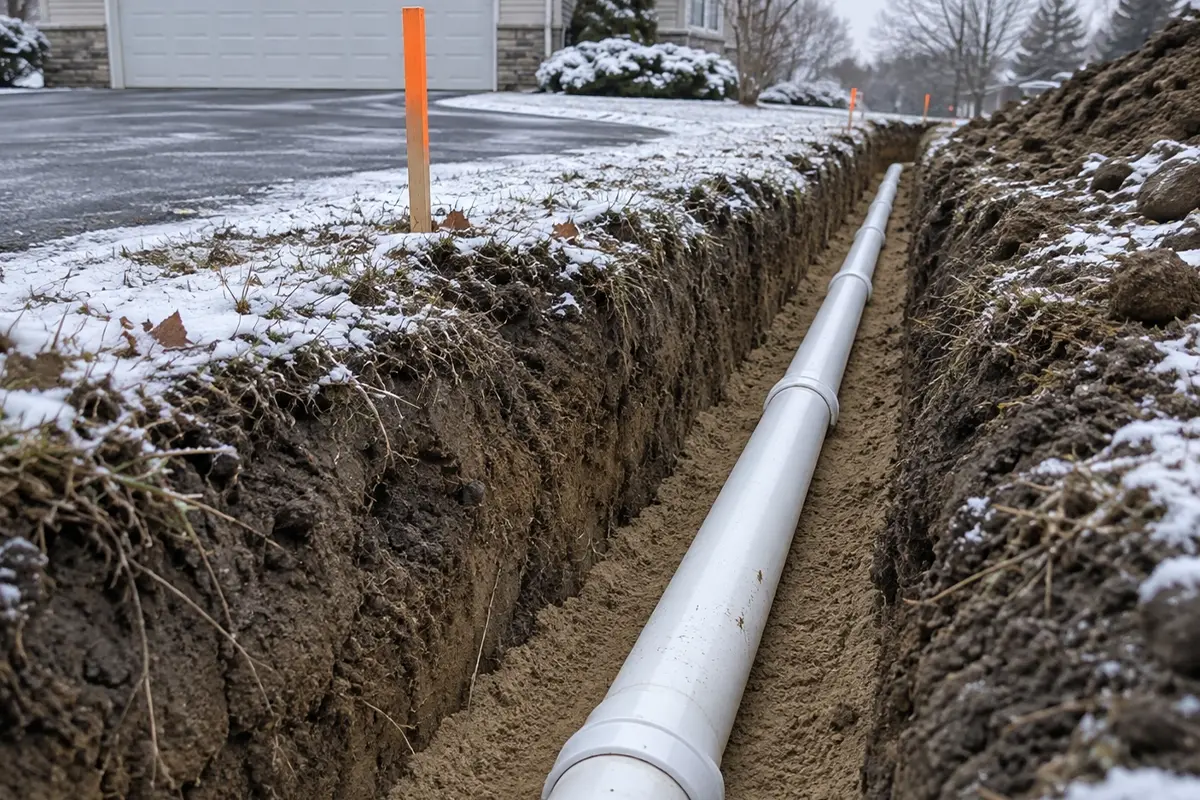
| Open-cut excavation | Collapsed, bellied, or misaligned lines, and sections under slabs or beside other utilities | More surface restoration; McCandless uses its own excavation crew |
Cast iron can be burst. In EPA’s fact sheet on pipe bursting, one example is a 1997 project in Stockbridge, Massachusetts, where a 1,550-foot pull replaced a 10-inch cast iron pipe with HDPE. EPA says bursting is most appropriate for pipes 4 to 24 inches in diameter, needs an insertion pit unless a manhole-to-manhole method is used, and isn’t recommended in soils that aren’t compressible, such as rocky or sandy soils. That fact sheet is general guidance written in 2006, so a camera and a site check decide what’s possible at your property.
Replacement material: McCandless replaces damaged cast iron with modern, corrosion-resistant pipe such as PVC or HDPE. It’s lighter, resists corrosion, and doesn’t suffer the rust scale that narrows old iron.
What Cast Iron Sewer Replacement Costs in Chautauqua County
Cost depends on the pipe, not just the date. McCandless’s cost guide gives these Jamestown ranges, and every job is quoted in writing after the camera inspection:
- Full sewer line replacement: usually about $3,500 to $12,000.
- Overall repair-to-replacement range: about $3,000 to $15,000.
- Typical time: simple repairs take roughly 4 to 8 hours, and a complete replacement takes 1 to 3 days depending on length and method.
What moves your number up or down:
- Length and depth. A longer or deeper line means more excavation, time, and equipment.
- Access. A line under open lawn is cheaper to reach than one under a driveway, mature landscaping, or a concrete slab.
- Method. Trenchless methods can cost more per foot, but they often save on landscaping and surface restoration. Collapsed or misaligned lines may still need open excavation.
- Restoration. Backfilling, regrading, and surface repair after excavation add to the total.
- Permits and inspections. The published city fees below are small next to the job, but they apply.
Cast iron is also not the only old material in the area. If you’re weighing other pipes in an older home, see our guide to galvanized pipe replacement costs in NY and our overview of types of pipes.
Permits and Inspections in Jamestown
Sewer replacement isn’t something to do without a permit. These details come from the City of Jamestown Code, Chapter 175 on licenses and permits (amended through April 27, 2026) and the city’s Sewer Use article, and they apply inside the City of Jamestown:
- A plumbing permit is required. The city lists a $30 plumbing permit for repairs and replacement, and $50 for sanitary sewer installation or replacement from the main to the house.
- Inspections carry their own fee. Outside inspections are $25 each, with a minimum of one per job, and the schedule lists $40 for other inspections, including demolition of a sewer line.
- A building sewer permit goes through the Board of Public Utilities. The code lists no fee for it. The applicant must notify the BPU when the building sewer is ready for inspection and connection, and the connection is made under BPU supervision.
- Work must follow code. Size, slope, alignment, materials, and methods have to meet the city’s building and plumbing code, and the connection to the public sewer must be gastight and watertight.
- Don’t start early. The city says all fees are doubled if an approved permit isn’t secured before work begins.
- Street work may need more. If digging reaches the street, the fee schedule also lists a $75 street opening permit.
Jamestown’s Board of Public Utilities also states that plumbing work inside the City must be done by a licensed Master Plumber, including broken pipes. Outside the City, in places like Lakewood, Falconer, or Dunkirk, your own municipality’s code enforcement office sets the permit rules, so ask before work starts. Fees and requirements change, so confirm current amounts with the city.
Should You Repair Now or Wait?
A cast iron sewer that is failing rarely gets better. Scale keeps building, joints keep opening, and a partial failure can become a full backup. McCandless’s guidance is to replace a line that is over 50 years old, has multiple problem areas, has collapsed or shifted, or keeps needing repairs, and to repair localized damage in newer pipe. The camera tells you which one you have.
To see what to expect from a project, our Jamestown service page and our sewer services page explain how McCandless handles sewer work from inspection to restoration.
Frequently Asked Questions
How long does cast iron sewer pipe last?
A commonly cited range is 50 to 100 years, but it varies with soil, water, and maintenance. McCandless puts typical life at 50 to 70 years and recommends an inspection for any pipe over 40 years old. A camera shows the pipe’s real condition.
How do I know if my cast iron sewer pipe needs replacing?
Warning signs include slow drains and recurring clogs, sewer odors, several fixtures backing up at once, wet or lush patches in the yard, and visible rust or flaking. A camera inspection confirms whether the cause is scale you can clean, or cracks, wall loss, or collapse that need repair or replacement.
Can a cast iron sewer pipe be lined instead of replaced?
Sometimes. CIPP lining fits minor to moderate damage in a pipe that is still aligned and structurally stable. Collapsed, shifted, or heavily corroded sections generally need replacement, and the camera inspection decides which applies.
Can cast iron be replaced without digging up my yard?
Often. Trenchless methods such as lining and pipe bursting work through small access points where the pipe qualifies. EPA documents cast iron being replaced by bursting. Sections inside the house or under a slab, or lines that have collapsed or shifted, may still need excavation.
Do I need a permit to replace a sewer line in Jamestown?
Yes. The City of Jamestown lists a plumbing permit and a sanitary sewer replacement permit from the main to the house, plus inspection fees, and a building sewer permit through the Board of Public Utilities. Fees double if the permit isn’t secured before work starts. Outside the City, check with your own municipality.
How much does cast iron sewer replacement cost in Chautauqua County?
McCandless’s cost guide puts a full sewer line replacement in Jamestown at about $3,500 to $12,000, with the broader repair-to-replacement range at $3,000 to $15,000. The final figure depends on length, depth, access, method, and restoration, and it’s quoted in writing after a camera inspection.
A cast iron sewer is a pipe to understand, not to fear. Many are still working, and some are close to done. Find out which you have with a camera, compare the options on the footage, pull the right permit, and fix it on your schedule rather than during a backup.
McCandless Plumbing & Excavation: Serving Chautauqua County Since 1975
McCandless is a family-owned plumbing and excavation company in Jamestown, licensed and insured in New York. It runs camera-first diagnostics and handles both trenchless repair and full excavation with its own crew, so there’s no subcontractor to wait on.
Call (716) 403-2478 for a free, written estimate after your camera inspection.
Not sure what’s under your yard?
Start with a sewer camera inspection. It shows the pipe’s real condition, so the decision between lining, bursting, and excavation comes from footage, not guesswork.
Schedule a Camera Inspection | (716) 403-2478